
Recent geopolitical instability, particularly ongoing tensions in the Middle East, has once again raised concerns about rising energy prices and their impact on electricity bills. Given Ireland’s exposure to international fuel markets—especially natural gas—it is understandable that households and businesses are concerned about potential price increases.
However, what is often less well understood is that Ireland’s electricity market is specifically focused on protecting consumers from this volatility. A number of mechanisms contribute to this, but two of the most important—particularly in the context of increasing renewable generation—are the wholesale market design, which prioritises the lowest-cost generation, and contracts for difference, which help limit excessive price increases by returning revenues to consumers when prices are high.
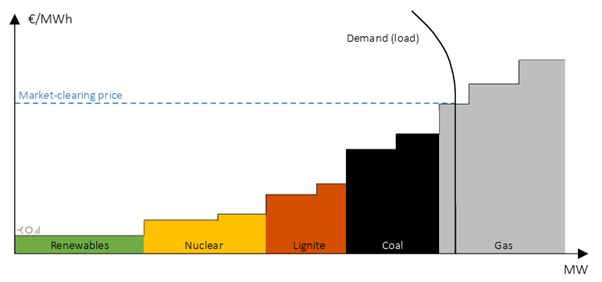
Ireland operates within the Single Electricity Market (SEM), which spans both the Republic of Ireland and Northern Ireland. The competitive wholesale market is based on a marginal pricing framework, meaning that electricity is dispatched from the lowest-cost generators first. In practice, this is reflected in the merit order curve—effectively the short-run supply curve—which ranks generators according to their marginal cost of production. Lower-cost generators are dispatched first to meet demand, with progressively more expensive units brought on as required.
The market price is then determined at the point where supply meets demand. This price reflects the cost of the most expensive generator needed to meet total demand and is paid to all generators in that trading period. In doing so, the market ensures that electricity is produced as efficiently as possible while maintaining a single, transparent clearing price. Importantly, the operation of this market ensures that consumers benefit directly from the most efficient and cost-effective sources of electricity available. Any deviation from this pricing mechanism, such as administratively imposed price caps or floors, would require intervention in dispatch decisions, determining which generators run and which consumers benefit, potentially leading to inefficiencies, distortions, or, in extreme cases, rationing of supply.
Figure 1: The Merit Order Curve for Electricity and Market Equilibrium (Hirth, 2026)
This is where renewable energy plays a crucial role. Wind and solar generation have extremely low operating costs. While Ireland’s current reliance on natural gas means wholesale prices (now mainly set by the price of gas) are more exposed to international volatility, as more renewables enter the system, they will displace this more expensive fossil-fuelled generation. This reduces the overall wholesale price of electricity through what is known as the merit-order effect. This is illustrated in the figure below.
Figure 2: The Merit Order Effect (German Renewable Energies Agency) [1]
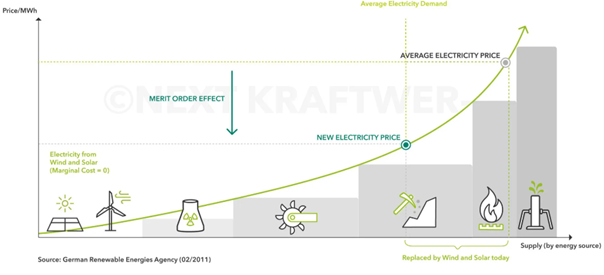
[1] As more renewable electricity enters the system, it displaces more expensive generation. This shifts the supply curve and lowers the price at which electricity is traded in the market. As a result, the overall wholesale price falls, reducing costs for consumers.
Evidence shows that renewables are already delivering tangible benefits with a significant reduction in Ireland’s reliance on imported fossil fuels and lower electricity prices. Analysis by Baringa[1] indicates that between 2020 and 2023 alone, renewable electricity reduced consumer electricity costs by approximately €1.7 billion, demonstrating the scale of these benefits.
[1] Baringa (2024). Good for Your Pocket: The Consumer Impact of Renewable Energy in Ireland. Baringa Partners (commissioned by Wind Energy Ireland).
The Renewable Electricity Support Scheme
To ensure renewable generation comes online as soon as possible, the Renewable Electricity Support Scheme (RESS) provides long-term support for renewable projects through competitive auctions. Under this scheme, generators receive a guaranteed strike price for their electricity. If market prices fall below this level, support payments are made through the Public Service Obligation (PSO) levy (which you see on your bill). However, when market prices exceed the strike price renewable generators must return excess revenues to the PSO fund. These returned revenues directly reduce the PSO levy paid by consumers and, in some cases, have resulted in refunds being applied to electricity bills (as seen in recent years). This ensures that cost savings flow back to consumers.
This ultimately means that rather than enabling “price gouging”, the market incorporates safeguards that limit excessive revenues and redistribute value when prices are high.
Looking ahead, the benefits of renewable generation are expected to increase further. Achieving Ireland’s target of 80% renewable electricity by 2030 is projected to reduce electricity system costs by approximately €610 million per year (Baringa, 2024). This reflects both lower wholesale electricity prices and reduced dependence on imported fossil fuels.
In this way, the transition to renewable energy is not only essential for decarbonisation—it is also central to delivering more stable, affordable electricity for consumers.
If you’d like to learn more about these concepts, here are some useful publications:
- ACER (2021). Preliminary Assessment of Europe’s High Energy Prices and the Current Wholesale Electricity Market Design. European Union Agency for the Cooperation of Energy Regulators.
- Baringa (2024). Good for Your Pocket: The Consumer Impact of Renewable Energy in Ireland. Baringa Partners (commissioned by Wind Energy Ireland).
- Baringa (2025). Cutting Carbon, Cutting Bills: The Impact of Wind Generation on Ireland’s Electricity System.
- Commission for Regulation of Utilities (CRU) (2025). Public Service Obligation Levy 2025/2026 Final Decision Paper.
- European Commission (2020). Energy Prices and Costs in Europe.
- Hirth, L. (2026). Marginal Pricing and the “Merit Order” Why the proposed state interventions in wholesale electricity prices are a bad idea. Neon Energy, commissioned by Eurelectric.
- International Energy Agency (IEA) (2023). Renewables 2023: Analysis and Forecast to 2028.
- SEMO (Single Electricity Market Operator) (n.d.). Capacity Market Settlements: Introduction and Overview of the CRM Settlement Process.
- SEMO (Single Electricity Market Operator) (n.d.). Strike Price and Reliability Options Training Materials.