EU Electrification Plan
The EAI Strategy Paper, ‘Electrifying Society,’ was developed in 2024 to identify barriers to electrification across sectors and to promote policy measures that will contribute to increased electrification rates in Ireland and reduce greenhouse gas emissions. The EU Commission in their Electrification Action Plan published 17/07/2026 sets a 46% indicative electrification target by 2040 with the new KPIs to support its attainment.
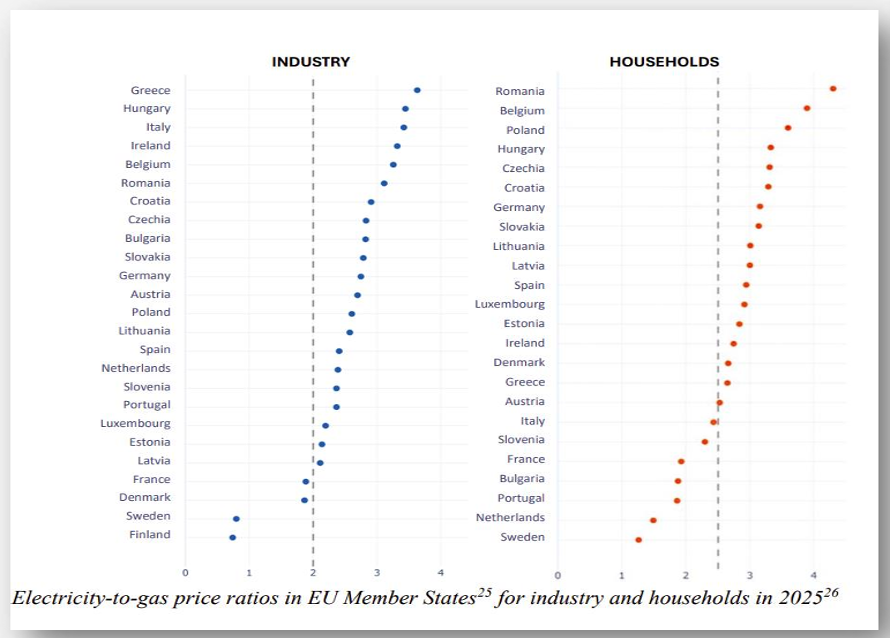
This plan represents a strong and positive step forward, recognising that electrification is the EU’s overarching strategy for delivering decarbonisation, competitiveness, and energy security. Some notable KPIs include increasing EU’s annual heat pump installations to 4 million, improving electricity-to-gas price ratios with a target of a maximum of 2:1 for industry and 2.5:1 for households by 2030 (as seen in the graph below, Ireland is currently about 3.3:1 for industry, but closer to the new 2030 KPI for households at about 2.75:1). Other targets include expanding district heating and cooling to supply 15% of heating and cooling demand and accelerating the annual growth of district heating and cooling networks to 6–7%.
Taxation & Subsidies
To ensure that electricity is not taxed more heavily than natural gas the Commission seeks, under the EU Energy Taxation framework, to create a more favourable tax environment for electrification and thereby improving the electricity to gas price ratio. The plan also proposes that environmental requirements for reduced or zero excise duties on electricity supplied to energy-intensive businesses would be considered satisfied, reflecting the contribution of electrification to decarbonisation and energy efficiency.
The Action Plan encourages Member States to make use of the existing flexibilities under the VAT Directive to apply lower VAT rates to key electrification technologies, helping to improve their affordability and accelerate uptake. It also promotes the development of social leasing schemes, supported by the Social Climate Fund, to ensure that low-income and vulnerable households can access clean energy technologies.
The Commission also gave an update on plans to reduce subsidies on fossil fuels to improve the business case for electrification. It noted that measures will be proposed on progressively phasing out fossil fuel subsidies as part of the post- 2030 Energy Union Package that is due in Q4, 2026.
Industrial electrification
The plan gives a clear intention to accelerate industrial electrification through targeted financial support, stronger demand for low-carbon European products and greater coordination between industry, technology providers, and governments. Measures include the proposed €100 billion Industrial Decarbonisation Bank, Innovation Funding to support industrial heat, potential mechanisms to aggregate industrial electricity demand and reduce PPA risks, and sector-specific electrification roadmaps. The Commission also plans to develop a map-based tool, “GeoDep,” to encourage cluster-based approaches that link industrial sites, low carbon energy providers, and data centres to share waste heat and flexibility. For Ireland, this could create opportunities to use abundant renewable electricity and waste heat to improve industrial competitiveness, while also increasing the need for more flexible electricity demand, storage, and investment in electrification technologies.
Wholesale electricity price vs low carbon electricity share
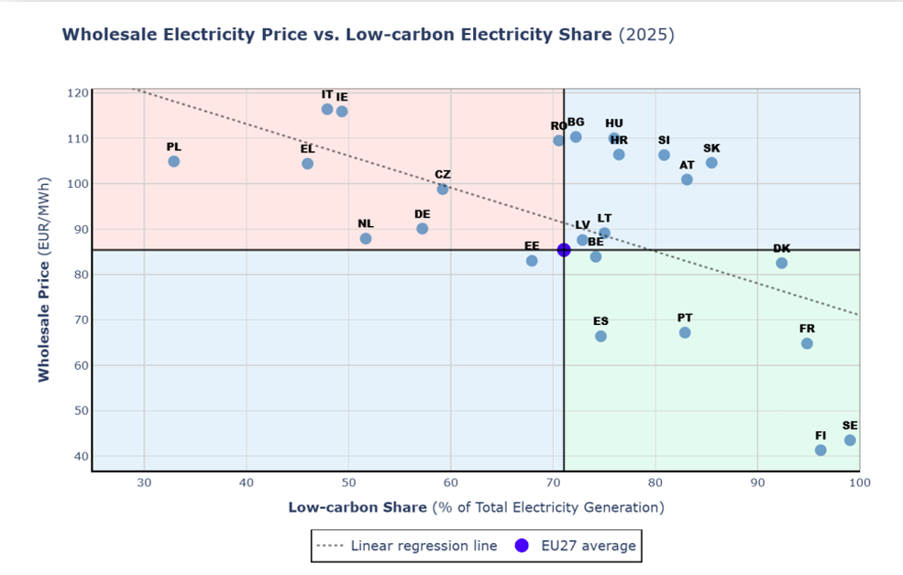
In the graph below, Ireland and Italy are the two most expensive Members States for the wholesale cost of electricity, at about €115/MWh. The 12-month average in Ireland is about €115/MWh, but the cost trajectory is still rising with the wholesale cost going up to €144.45/MWh in May 2026 and €135.50/MWh in June 2026.[1] Just under 50% of total electricity generation in Ireland is from low-carbon sources, with Finland and Sweden leading the way in the bottom right corner of the graph, where the wholesale cost is just over €40/MWH and nearly 100% of electricity is generated from low-carbon sources. This graph clearly illustrates a linear regression line between the share of low-carbon electricity generation and wholesale electricity prices: the higher the share of low-carbon generation, the lower the wholesale electricity price tends to be (France, Finland, Sweden). Conversely Poland, Italy and Ireland show higher prices with a lower share of low-carbon generation.
While the overall direction is encouraging, Eurelectric, the association for the electricity sector in Europe, notes that several important recommendations were not included, notably the development of an EU Heating and Cooling Strategy, the integration of the Product Environmental Footprint (PEF) that measures the ecological impact of a good or service across its entire lifecycle, stronger support for electrification under security-related funding instruments, and the establishment of a tripartite agreement to accelerate electrification across stakeholders. EAI looks forward to contributing to Eurelectric advocacy on the electrification plan and working with the relevant stakeholders at a national level to increase the rate of electrification through progressive policies and incentives.
[1] Wholesale Electricity Prices in Ireland (2026)