
Understanding your electricity bill
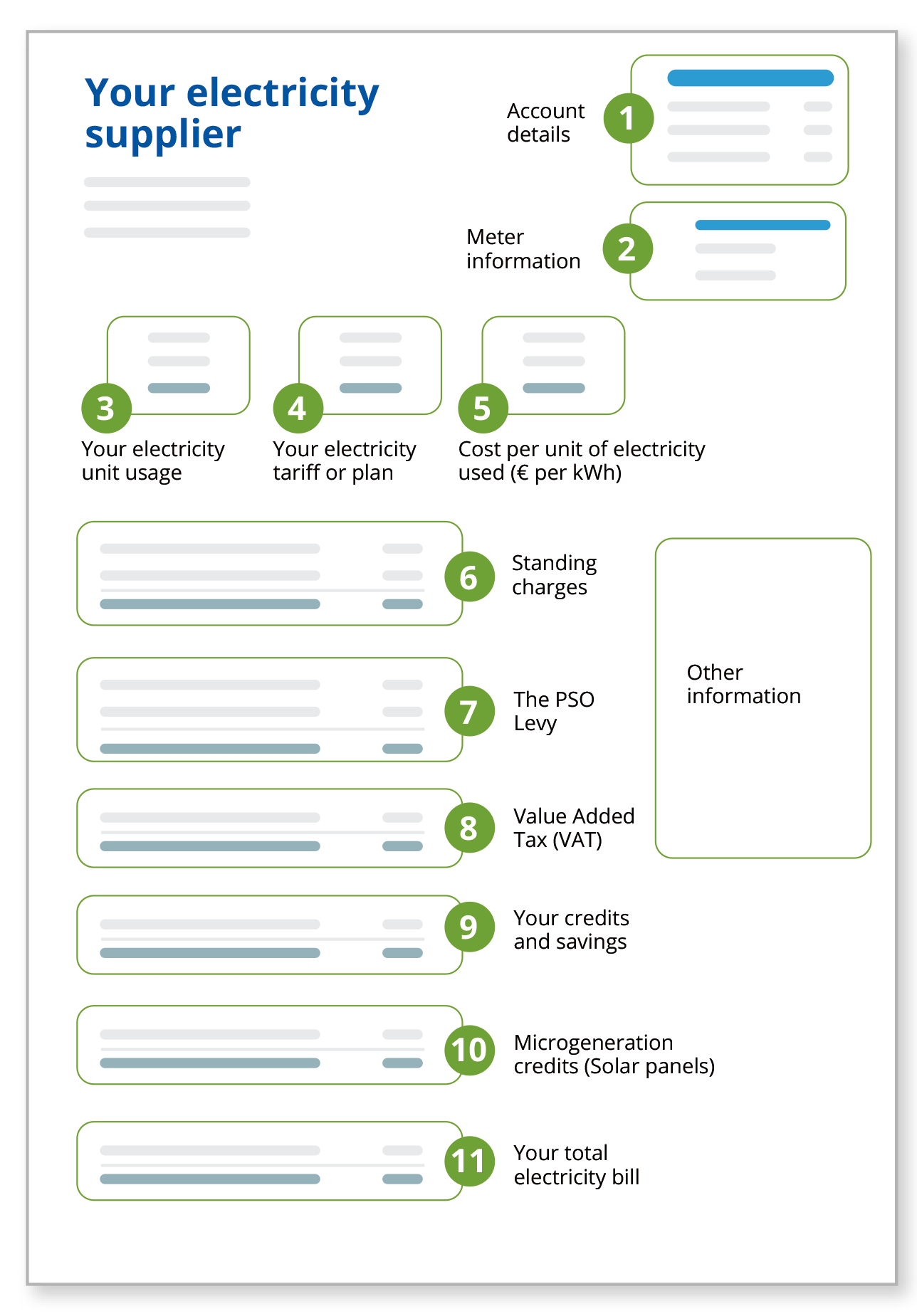
1 – Account details
Here you’ll find your account number, your tariff or plan name, and your contract end date. If you’re not currently in contract, a contract end date is not included.
2 – Meter information
This shows your meter number and MPRN (Meter Point Reference Number). You need your MPRN if sending your supplier a meter reading.
3 – Your electricity unit usage
Every year the average Irish household uses about:
- 4,200 kilowatt-hours (kWh) of electricity
- 11,000 kWh of gas
Your electricity usage depends on things like:
- The size of your home
- How well it keeps in heat and is insulated
- The appliances you use and how efficient they are
- The number of people in your home.
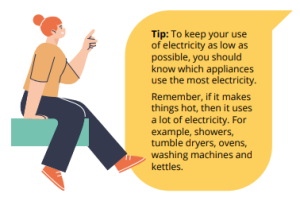
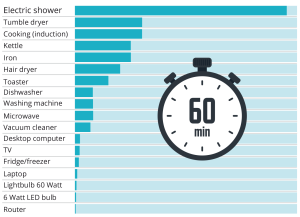
In the image below, you can see the electricity different household appliances use per hour.
At the top, we have the highest users such as the electric shower and tumble dryer and at the bottom, the lowest users such as a light bulb or router for your internet
4 – Your electricity tariff or plan
The unit price you pay per kWh depends on:
- Your electricity tariff or plan
- The time you use the electricity
- The mix of fuel used to generate the electricity. For example, is it a fossil fuel like coal or gas or renewable like solar or wind?
Your tariff decides how your electricity is charged per kWh. Below we outline some of the most popular electricity tariffs or plans. Different suppliers can have different names for tariffs.
| Type of tariff or plan | This is the same price no matter the time of day. |
|---|---|
| A standard flat-rate tarif | This is the same price no matter the time of day. |
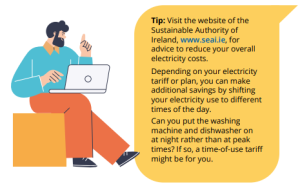
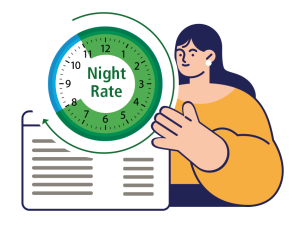
| A day/night tariff (time-ofuse tariff) | This offers different prices depending on the time of day. Daytime is 8am – 5pm and 7pm – 11pm Nighttime is 11pm to 8am. (This may vary with supplier.) |
| A smart meter plan | This plan has more options, with a timeof-use smart tariff offering different prices based on the time of day. |
| An electric vehicle (EV) plan | This provides an off-peak rate to charge your EV at home at certain hours of the day. (Peak being 5pm-7pm usually.) |
| Free weekend plans | Some suppliers offer free weekend plans. This is usually where you choose to have either Saturday or Sunday free of charge and a flat rate the rest of the week. |

5 – Cost per unit of electricity used (€ per kWh)
This pays for the generation of your electricity and the fuel used. To protect customers from sudden price increases on the global market, suppliers often buy electricity in advance. This is called “hedging”.
The cost per unit of electricity also includes charges that are set by the Commission for Regulation of Utilities (CRU). These costs help to:
- Maintain and upgrade the electricity network
- Make sure there is enough electricity to avoid blackouts (when electricity is unexpectedly cut off)
- Connect new homes and businesses to the electricity grid
- Run the electricity system energy market.
These charges are collected by electricity suppliers and are passed to EirGrid, ESBN and SEMO. The CRU ensures these charges are fair and transparent.
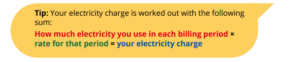
Tip: Your electricity charge is worked out with the following sum:
How much electricity you use in each billing period × rate for that period = your electricity charge
6 – Standing charges
Standing charges apply even when you don’t use electricity. This charge is applied for each day of the billing period. A billing period is generally about two months or 60 days. However, how often you are billed and the standing charge can vary among suppliers.
Supplier costs explainer
In the price you pay, suppliers include costs such as:
- Rent and wages
- Insurance
- Customer service
- Advertising and digital platforms
- Regulatory and policy obligations
- Bad debt (debt that is unlikely to be paid)
- A profit margin
- Financing costs.
7 – The PSO Levy
The Public Service Obligation (PSO) Levy is a charge that pays for developing renewable energy. This reduces Ireland’s use of fossil fuels (like coal and gas) that can rise and fall in price. It was introduced by the government in 2010.
8 – Value Added Tax (VAT)
To help lower electricity costs, the government has reduced VAT on electricity from 13.5% to 9% until the end of 2030.
9 – Your credits and savings
You can take advantage of supplier discounts for:
- Paying by direct debit
- Using online billing
- Loyalty rewards and vouchers.
Actual discounts and savings may vary depending on your supplier and tariff plan
10 – Microgeneration credits (Solar panels)
If you have solar panels, you can take part in Ireland’s Microgeneration Support Scheme. This lets you:
- Use your own solar energy to reduce the units of electricity you pay for and your bill.
- Sell surplus (extra) electricity you don’t use back to the grid. You can earn up to €400 per year tax-free from these payments
11 – Your total electricity bill
Your total electricity bill is the total of all the parts above.
Can I change how often I am billed?
Electricity bills are usually sent every one to two months, depending on your supplier. If this doesn’t suit, you can contact your supplier to arrange a way to pay that works better for you.
For example, you can choose:
- Monthly level payments to spread the costs evenly across the year
- Bi-monthly billing to pay for the electricity used over the previous two months
- A pay-as-you-go plan to pay for the energy as you use it. This is usually through a smart phone application or online account with your supplier

